Monday, April 22, 2013

Elevator Magic

-->


Author: Stuart J. Murphy
Grades: K-1


COMMON CORE STANDARDS:

  CCSS.Math.Content.K.OA.A.1 Represent addition and subtraction with objects, fingers, mental images, drawings, expressions, or equations.

  CCSS.Math.Content.K.OA.A.2 Solve addition and subtraction word problems, and add and subtract within 10

  CCSS.Math.Content.1.OA.A.1 Use addition and subtraction within 20 to solve word problems involving situations of adding to, taking from, putting together, taking apart, and comparing, with unknowns in all positions.

·  CCSS.Math.Content.1.OA.B.4  Understand subtraction as an unknown-addend problem. For example, subtract 10 – 8 by finding the number that makes 10 when added to 8.


SUMMARY: This book is about a boy that visits his mother at work on the tenth floor. He has to help his mother run a few errands in the building before they leave. But there is a catch! He has to calculate the different stops they have to make to know which button he needs to press.  This book shows how easy it is to bring everyday concepts and ideas into the classroom and at home.

RATING: I give this book five stars. It can be incorporated with the number line and makes the lesson concrete, relatable, and makes subtraction fun.
 
ACTIVITY:  Objects that require subtraction.

·      Students would be placed in groups of two and given worksheets and grapes or M&M’s.
·      Students would complete 4-5 questions on the worksheet using the M&M’s or grapes.
I have 10 grapes and I ate 2 how many do I have left?
I have 8 grapes and I gave 3 to a friend how many do I have left?
·      After 15 minutes class will then regroup, discuss worksheet and answers on the smart board.


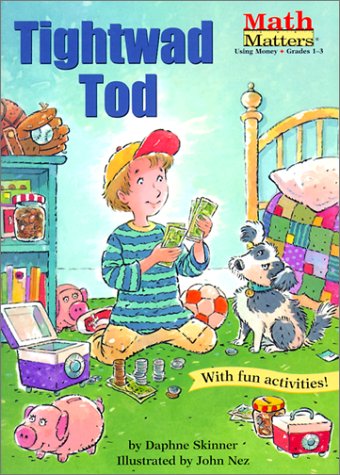
Title: Tightwad To
Author: Daphne Skinne
Illustrator: John Nue 
Recommended grade level: 2 and up


Common Core Mathematics Standards:

Operations and Algebraic Thinking 2.0 A

Represent and solve problems involving addition and subtraction.

1. Use addition and subtraction withing 100 to solve one -two step problems involving situations of addition to, taking from, putting together, taking apart,  and comparing with unknown in all positions, example by using drawings equations with symbols for the unknown to represent the problem.


Add and Subtract within 20.

2. Fluently add add subtract with 20 using mental strategies. By the end of grade 2, know from memory all sums of two-one-digit number.

MEASURE AND DATA.
Work with time and money.

Solve word problems involving dollar bills, quarters, dimes, nickels and pennies, using $ and cent symbols appropriately. Example if you have two dimes and three pennies, how many cents do you have?

Summary.

This is a story about a little boy named Tod.Tod is a tightwad or a miser. He liked money. He liked geetting his allowance. He liked getting his birthday checks. Once he found a nickel on the street and it made him happy all day long.Tod never spends his money.When he got some money, he put it away. He had four piggy banks, a penny jar, a money clip, and a safe. They were all full.Each time they call him to go and watch a movie, or go to the park to play ball, he would say he is busy and he cannot go. One day his brother Ernest said, i am starting to worry about you. All you do is counting money.Would you be able to spend all this 20 dollars or you give it back plus five dollar bill.Tod said may be. Tod took the money and spent it all.When he returned home, Earnest shook his hand and said you win. Now you are not a tightwad at all.

Rating.

I give this book a rating of four. I like this book because it brings about both addition and subtraction to the classroom. It addresses both addition within 20 and addition from 1 to 100. It gives the student an understanding of how to add and subtract using dollar bills and coins like quarters, nickels and dimes.

Classroom Ideas.

This book will help students to develop their addition and subtraction skills. For older Kids, more complex activities could be used using this book. This book could also be used to interpret and solve word problems that involves addition and subtraction. However, it is important also to note that, younger students would not have the cognitive developmental maturity to be able to mentally manipulate and process all types of mathematical standards. The standards to be addressed however depends on the grade level.

Monday, April 15, 2013

Ready, Set, Hop! Posted by Elaine Brito


Title: Ready, Set, Hop!
Author: Stuart J. Murphy
Illustrator: Jon Buller
Recommended Grade Level: 2 and up

Common Core Mathematics Standards Addressed:
CCSS.Math.Content.2.MD.B.5 Use addition and subtraction within 100 to solve word problems involving lengths that are given in the same units, e.g., by using drawings (such as drawings of rulers) and equations with a symbol for the unknown number to represent the problem.
CCSS.Math.Content.2.MD.B.6 Represent whole numbers as lengths from 0 on a number line diagram with equally spaced points corresponding to the numbers 0, 1, 2, ..., and represent whole-number sums and differences within 100 on a number line diagram.
CCSS.Math.Content.2.OA.A.1 Use addition and subtraction within 100 to solve one- and two-step word problems involving situations of adding to, taking from, putting together, taking apart, and comparing, with unknowns in all positions, e.g., by using drawings and equations with a symbol for the unknown number to represent the problem.
CCSS.Math.Content.2.OA.B.2 Fluently add and subtract within 20 using mental strategies. By end of Grade 2, know from memory all sums of two one-digit numbers.

Summary: This story is about two frog friends, Matty and Moe, who engaged in a hop completion to decide who needs to take fewer hops to win. They both hopped to the set target while counting. After that, they decided who wins by comparing the amount of hops each took to cover the set distance. They then create simple equations to add and subtract the hops they took to conclude who is the winner and better hopper.

Rating: ***** I recommend this book as it helps to teach children the concept of adding and subtracting as well as building a simple equation. In addition, it also addresses measurement topic. While reading and finding out who is the better hopper, students will count and practice their word problem solving abilities and adding and subtracting skills. The story of Matty and Moe make the mathematical problems fun and entertaining for students.

Classroom Ideas: This book is great to introduce addition, subtraction and measurement subjects. Students could show their understanding of word problems by identifying the words that equals addition or subtraction, for example "more" equals addition and "less" equals subtraction. Many other lessons could be created to expand the concept of this book. One activity could be students counting the number of steps from their seats to the front board. After they can determine who is closer to the board and rank on a first, second, third and so on order. They can also find out the dimensions of their classroom, the length of their desks or height of their chairs by measuring with other objects such as pens and books.  

Wanda Martinez- What Shape is it?


Title: What Shape is it?
Author: Henry Pluckrose
Illustrator: Steve Shott
Recommended Grade Level: K- 2
Common Core Mathematics Standards Addressed
K.G.B.4 Analyze and compare two- and three-dimensional shapes, in different sizes and orientations, using informal language to describe their similarities, differences, parts (e.g., number of sides and vertices/“corners”) and other attributes (e.g., having sides of equal length).
K.G.B.5 Model shapes in the world by building shapes from components (e.g., sticks and clay balls) and drawing shapes.
.K.G.B.6 Compose simple shapes to form larger shapes. For example, “Can you join these two triangles with full sides touching to make a rectangle?”
Summary: What Shape is it?  is a simple, easy to read book that introduces the concept of shapes to young readers.  The book begins by pointing out the different shapes that we can find around us. It defines simple geometrical terminology, such as angle, symmetry and face.What Shape is it? provides examples of shapes that have curved and flat surfaces, in addition to curved and straight edges. It teaches students about angles with illustrations and descriptions of angle formation. This book demonstrates both tridimensional shape, such as cubes, and shapes that have no corners, i.e., circles.  It teaches students about the difference in tessellating shapes and shapes that always leaves gaps among themselves.  This book relates shapes with objects, for example: calculators, balloon, clock relate to rectangle, round, and circle respectively; constructions such as the pentagon and pyramids relate to pentagons and triangles and foods like tomatoes, eggs, oranges, and pizza are related to their respective shapes.
Rating: I recommend this book because it is designed to encourage children to think about the concepts that form part of their world.  This book has many photographs that can generate discussion in the classroom and children will share their ideas about the different shapes represented in the book.
Classroom Ideas: This book can be used to introduce shapes and angles. It can also be used to introduce fractions. For example, teachers can draw and use a pizza shape to introduce fractions. Students can search around their classroom to find shapes that are similar to the shapes in the book.

Friday, April 12, 2013

Betcha! Math Start Level 3

-->


-->

Title: Betcha! Math Start Level 3

Author: Stuart J. Murphy Illustrated: S. D. Schindler,
Recommended Grade Level: Grade 2-4 
Common Core Mathematics Standards Addressed:
CCSS.Math.Content.2.OA.C.4 Use addition to find the total number of objects arranged in rectangular arrays with up to 5 rows and up to 5 columns; write an equation to express the total as a sum of equal addends.
CCSS.Math.Content.2.OA.A.1 Use addition and subtraction within 100 to solve one- and two-step word problems involving situations of adding to, taking from, putting together, taking apart, and comparing, with unknowns in all positions, e.g., by using drawings and equations with a symbol for the unknown number to represent the problem.1
Summary: 
-->
Summary: Two friends play a guessing game and discover  a rewarding experience.  They enter a contest and win two free tickets to an All-Star Game all because of their estimating skills. They both used different strategies to guess how many people are riding their bus, the cost of a bunch of toys, and how many jelly beans fill a jar.

Rating: ***** I highly recommend this book as it stresses the importance of estimation.  The story provides a connection to real-life mathematical experiences.

Classroom IdeasThis book can be used with several mathematical topics such as, addition, multiplication, and estimation. Students can discuss real life occurrences such as :ordering pizza to feed a number of people, how many tasks they can complete before going to basketball practice or music lessons. Students could also come up with their own idea of estimating problems.